REVIEW · KATHMANDU
Everest Base Camp Trek with Helicopter Return from Gorakshep to Lukla
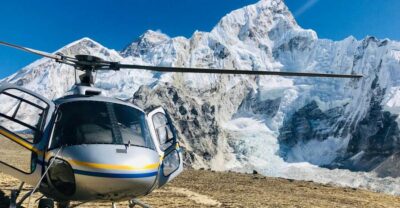
The clever part of this 12-day Everest Base Camp trek comes at the end: after reaching Base Camp and climbing Kala Patthar, you avoid the long walk back by taking a scenic helicopter flight from Gorakshep to Lukla. You still earn the mountain experience on foot, but save several tiring days on the return route.
I like the careful acclimatization plan, with rest and viewpoint walks at Namche Bazaar and Dingboche. I also like the practical support: a licensed English-speaking guide, one porter for every two people, filtered trail water, an oxygen monitor, meals, permits, and internal flights are included. The main drawback is the price, $3,000 per person, and the demanding altitude, with Kala Patthar reaching 5,555 meters.
Key points to know before booking
- The route reaches 5,365 meters at Everest Base Camp and 5,555 meters at Kala Patthar, so moderate fitness is essential.
- The return helicopter flight lasts about 20 minutes from Gorakshep to Lukla, depending on weather and flight conditions.
- Two acclimatization days are built in, one around Namche Bazaar and one with a climb to Nangkartshang Peak above Dingboche.
- The package includes a lot for the price, including meals, lodging, permits, porters, guide services, Kathmandu hotels, and internal airfare.
- The group is capped at 14 people, with a minimum booking of two.
- Guide and porter care is a major part of the experience, with guides such as Raj, Ram, Madan, and Rajendra praised for encouragement and close attention.
Why the helicopter return changes the trek
The classic Everest Base Camp route asks you to walk back over much of the same ground after reaching the goal. That return is not easy. Your legs are tired, the air is thin, and the scenery you admired on the way up can begin to feel repetitive.
This version removes that long descent from Gorakshep to Lukla. After your Base Camp visit and Kala Patthar climb, you take a shared helicopter for a scenic flight of about 20 minutes to Lukla. From there, the normal plan is to fly back toward Kathmandu, although mountain weather can affect timing.
I like this design for two reasons. First, it puts the hardest walking where it matters most: the approach to Base Camp and the climb to Kala Patthar. Second, it gives you a short aerial look at the route you have just walked. You pay more than you would for a standard trekking package, but the helicopter can save several days and reduce the physical demand of the return.
The flight is not a magic shortcut around the hard work. You still spend most of the trip walking at high altitude. You cross bridges, climb stone paths, pass Buddhist monuments, and follow the Khumbu Glacier. The helicopter simply changes the final chapter.
More Helicopter Transfers in Kathmandu
- Everest Base Camp Trek with Helicopter Return to Lukla – 10 Days
★ 5.0 · 34 reviews - Everest Base Camp Trek with Helicopter Return -11 Days
★ 5.0 · 12 reviews - Helicopter Return Everest Base Camp Trek, KTM-LUKLA & Gorakshep-KTM by Heli
★ 5.0 · 9 reviews
Days 1 and 2: Kathmandu to Phakding by way of Lukla
Your first day is straightforward. An airport representative meets you at Tribhuvan International Airport and transfers you to a hotel in a private tourist vehicle. A pre-trip meeting introduces you to the guide and gives you time to organize your equipment before leaving Kathmandu.
The second morning begins early at Kathmandu’s domestic airport. The flight to Lukla takes about 35 minutes and lands at Tenzing and Hillary Airport, at roughly 2,804 meters. This is not a long travel day on paper, but the early start and change in altitude set the tone for the trek.
From Lukla, you walk toward Phakding. The route begins among green forest and follows the Dudh Koshi River. You will cross suspension bridges decorated with prayer flags, an early taste of the combination of scenery and exposure that defines this route.
Phakding is a useful first stop because it keeps the opening walking day manageable. Accommodation is included, and the package provides meals during the trek. Lodging is generally twin-sharing, with attached toilets specifically listed for Lukla, Phakding, and Namche.
Day 3: The long climb to Namche Bazaar
The walk from Phakding to Namche Bazaar takes about six hours. The trail continues beside the Dudh Koshi, crossing the river several times before turning upward toward the main Sherpa trading center.
This is where the trek begins to feel serious. The bridges are exciting, but the climb to Namche is the real test. You gain altitude steadily, and your body has to work harder with every uphill section.
Namche Bazaar is more than a place to sleep. It is the main settlement in the Khumbu region and an important stopping point for acclimatization. This itinerary gives you a separate day here rather than rushing onward, which is one of its strongest features.
Your guide and porters carry much of the practical burden. One porter is assigned for every two people, while staff costs, insurance, equipment, and medicine for the staff are covered in the package. You still need to carry a daypack with personal essentials, but your main luggage is handled for you.
Day 4: Acclimatization and the Everest View Point
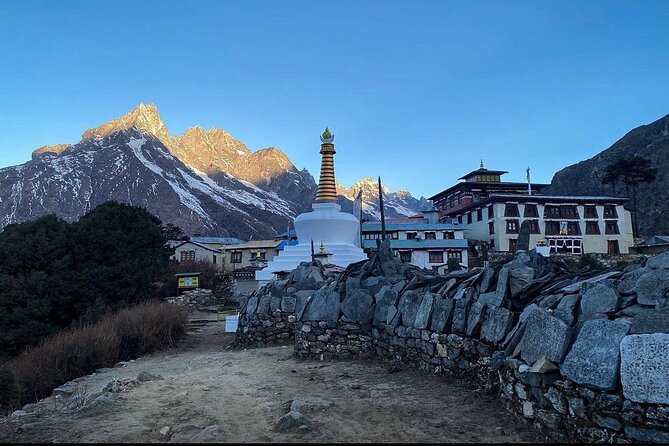
The Namche acclimatization day is not a day of doing nothing. You take a short hike around the settlement and toward an Everest viewpoint, with mountain views and a sunrise opportunity.
The purpose is simple: spend time at altitude, then return to sleep at the same elevation. That helps your body adjust before the trail climbs higher. The short walk also gives you a first clear look at the Himalayan peaks, provided the weather cooperates.
I like that the itinerary uses a viewpoint walk instead of treating acclimatization as wasted time. You get scenery, movement, and a chance to test how you feel before continuing. If you develop symptoms of altitude sickness, this is also an important moment to tell your guide.
The company includes a first-aid kit and an oximeter for checking oxygen saturation. That does not remove the risk of altitude illness, but it gives the guide another practical tool for monitoring the group.
More Helicopter Transfers in Nepal
- Everest Base Camp Trek with Helicopter Return – 10 Days
★ 5.0 · 9 reviews - Everest Base Camp trek with Helicopter return 9 days
★ 5.0 · 8 reviews
Day 5: Forest paths and Tengboche Monastery
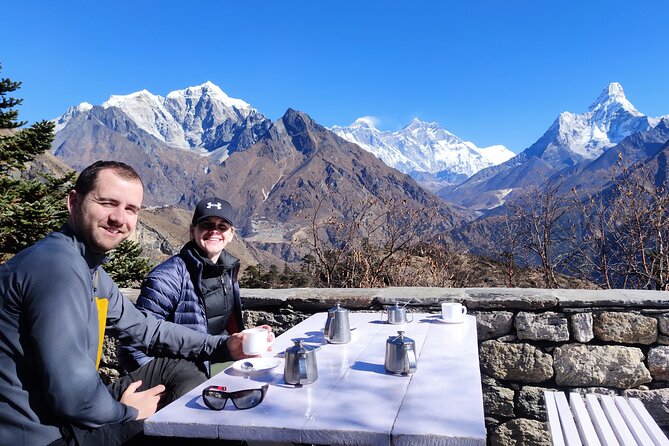
From Namche, the trail follows the rushing Dudh Koshi through a route known for mountain views. You eventually reach Tengboche at about 3,860 meters.
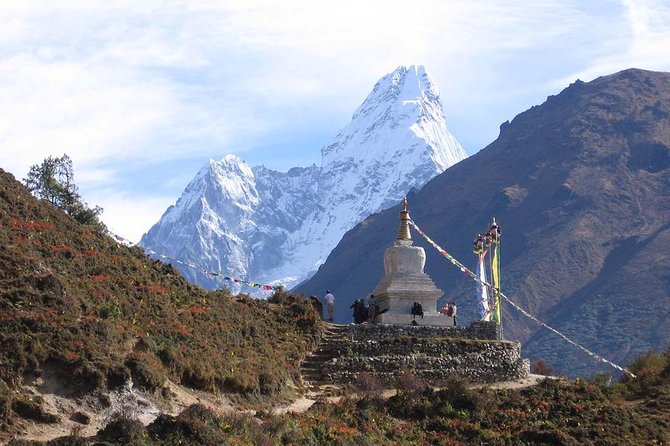
Tengboche is one of the most meaningful stops on the route because of its monastery. The setting combines Buddhist prayer flags, mani stones, forest, and high peaks. Inside the monastery, you can see religious artwork and a working spiritual center rather than a simple photo stop.
The walking day is listed as roughly 16 hours in the supplied schedule, which appears to refer to the full activity window rather than nonstop hiking. Still, you should expect a substantial day on foot. The trail rises and falls, and the altitude makes even familiar distances feel longer.
Day 6: Pangboche and the approach to Dingboche
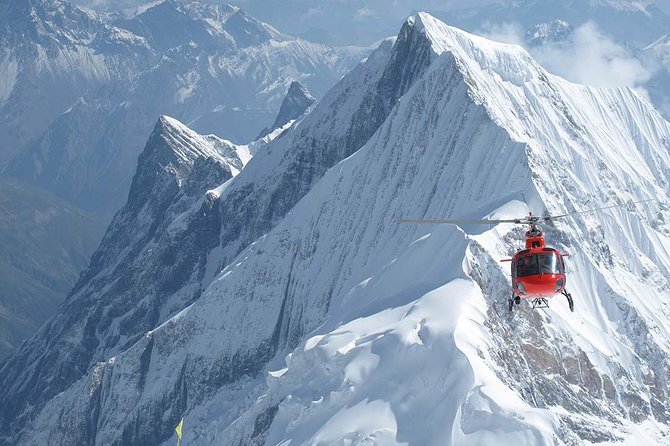
The trail drops from Tengboche toward Debuche, crosses the Imja Khola on another suspension bridge, and climbs through Pangboche. Mani stones line parts of the route, adding a clear cultural element to the walk.
From Pangboche, the trail continues uphill toward Dingboche. The settlement sits higher and feels more exposed than the forested country below. This is a point where the trek changes character: less woodland, more open slopes and wide views.
Dingboche is an important rest point before the trail moves toward Lobuche and the glacier. You have already gained substantial altitude, so the following acclimatization day matters.
Day 7: Nangkartshang Peak above Dingboche
You do not advance toward Base Camp on this day. Instead, you climb Nangkartshang Peak above Dingboche and return to the same lodging.
This is a smart use of time. The climb gives you additional altitude exposure without forcing you to sleep much higher that night. It also rewards you with a broad viewpoint over the surrounding peaks and valleys.
Do not mistake the word acclimatization for easy. At this height, a short uphill walk can feel demanding. The point is controlled effort, not speed. Follow your guide’s pace and speak up if you feel unwell.
The guides receive some of the strongest praise in the supplied feedback. Names including Raj, Ram, Madan, and Rajendra appear repeatedly, along with porters such as Bishal, Krishna, Probin, Saman, Jit, Sher, Girija, and Pesal. You are not guaranteed a particular staff member, but the repeated focus on encouragement, attention, and steady support tells you what to expect from the service when the team is working well.
Day 8: Lobuche and the memorial stones
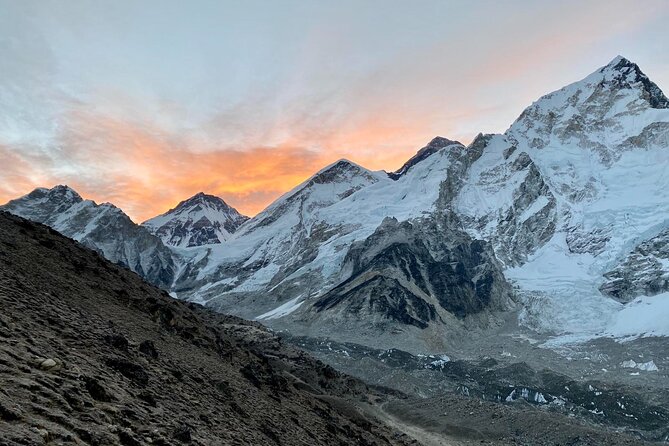
The route from Dingboche to Lobuche follows the lateral moraine of the Khumbu Glacier. This is a visual shift from rivers and forests to rock, ice, and high open ground.
Along the trail, stone memorials honor climbers who died on nearby peaks. They add a sober note to an otherwise thrilling day. Everest is not only a famous name on a map. The mountains are physically demanding and carry real risk.
Lobuche is the staging point for the push to Base Camp. The air is thin, the nights are cold, and the walking can feel slow. You should keep your expectations realistic: at this altitude, finishing the day matters more than covering ground quickly.
Day 9: Everest Base Camp at 5,365 meters
This is the central goal of the trek. From Lobuche, you walk toward Gorakshep and then continue along the Khumbu Glacier to Everest Base Camp, at about 5,365 meters.
The route is difficult because of the altitude and the uneven glacier-side path. Base Camp itself changes with the season. In spring, climbing activity can make the area busier and more visually active, but the schedule does not promise a particular camp display or climbing condition.
Reaching Base Camp is satisfying because you have arrived there under your own power. You do not need mountaineering equipment for this walk, but you do need patience, a reasonable fitness level, and the ability to handle a long day at high altitude.
The shared helicopter return does not begin at Base Camp. You return to Gorakshep, which is the departure point for the flight the following day. That distinction matters when you picture the final two days.
Day 10: Kala Patthar at 5,555 meters
The climb to Kala Patthar is often the hardest and most rewarding walking day. The peak rises to about 5,555 meters, higher than Base Camp, and the ascent is steep enough to test anyone.
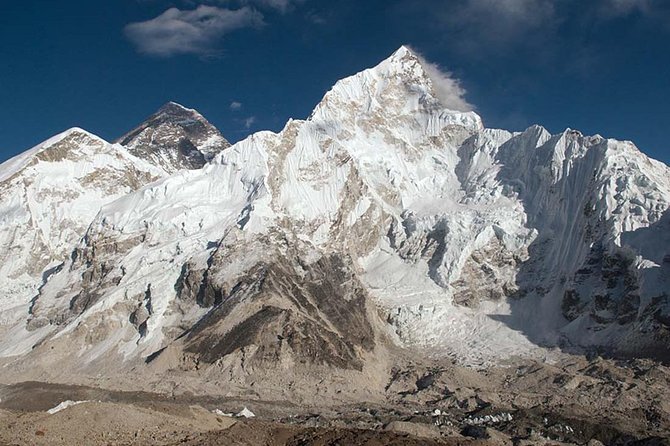
The reward is the mountain view. Kala Patthar is known for its broad outlook toward Everest and the surrounding Himalayan peaks. The itinerary describes this as the place for the most magnificent views of the trek, though clear conditions are never guaranteed in the mountains.
You should treat this as a serious effort, not a casual viewpoint walk. The day comes after the Base Camp excursion, when your body is already tired. A guide who keeps the group together and watches for altitude problems is especially valuable here.
After the climb, you return to Gorakshep. The helicopter flight is planned for the next day.
Day 11: Helicopter from Gorakshep to Lukla
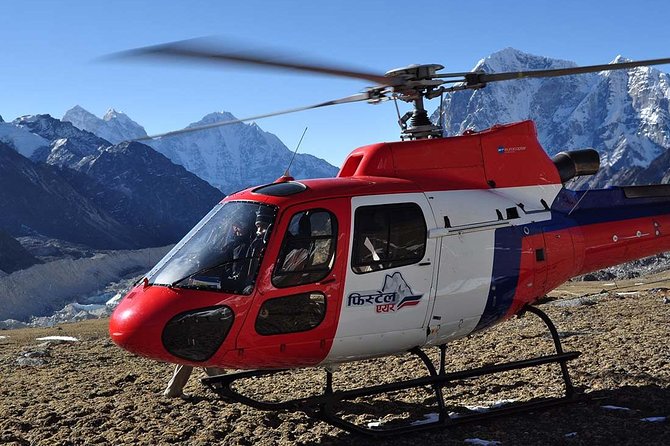
The helicopter flight is the tour’s defining convenience. From Gorakshep, you take a shared helicopter to Lukla, with the scenic flight listed at about 20 minutes.
Flying over the route gives you a completely different view of the Khumbu region. You have spent days seeing the trail from river level and mountain paths. From the air, the scale of the valleys, ridges, and glacier country becomes easier to grasp.
The flight is weather dependent. The cancellation terms specifically note that poor weather can force a different date or a full refund for the experience, but mountain transport can also require patience and schedule flexibility. Ask the operator how they handle a delayed helicopter or a missed onward flight before departure.
The itinerary also refers to a 35-minute scenic flight back toward Kathmandu after reaching Lukla. In practical terms, the helicopter return and the Lukla to Kathmandu flight are separate parts of the journey. Confirm the exact flight sequence and timing with the operator before you set up any tight international connection.
Day 12: Departure from Kathmandu
The final day is reserved for transfer to Tribhuvan International Airport. Airport pickup and drop-off are included at the start and end of the trip, using a private tourist vehicle.
Two nights in a three-star Kathmandu hotel are included, with breakfast. Lunch and dinner in Kathmandu are not included, so keep some money available for those meals. Drinks, trekking equipment, Nepal’s entry visa, international airfare, travel insurance, and tips are also outside the package.
What $3,000 includes, and what it does not
At $3,000 per person, this is not a budget trek. The price makes more sense when you count what is bundled into it:
- Airport, hotel, and airport transfers
- Two Kathmandu hotel nights with breakfast
- Trekking accommodation
- A licensed English-speaking guide
- Porters, with one assigned per two people
- Staff wages, insurance, equipment, and medicine
- Everest National Park and TIMS permits
- Kathmandu to Lukla and Lukla to Kathmandu airfare
- Shared helicopter flight from Gorakshep to Lukla
- Breakfast, lunch, and dinner during the trek
- Filtered trail water
- Seasonal fruit
- A duffel bag, trekking map, and sun hat
- Government taxes and administrative costs
The helicopter is the major value question. If you want the full return walk, another itinerary may cost less. If you want to reach Base Camp but prefer to avoid several days of retracing the route, the added cost has a clear purpose.
You still pay separately for personal gear, alcoholic and other drinks, Kathmandu lunches and dinners, insurance with emergency rescue and evacuation cover, international flights, visa costs, and tips. Tipping is expected, so include it in your working budget.
Who will enjoy this trek most
This trip suits you if you want a serious Himalayan walk with strong logistical support and a shorter return. It is also a good fit if you prefer a small group rather than a large commercial departure, since the maximum is 14 people.
You should have at least moderate physical fitness. The itinerary includes long walking days, repeated climbs, suspension bridges, and altitudes above 5,000 meters. No guide or helicopter can guarantee that your body will adjust well.
The trek works especially well for people who value support. You receive a local guide, porter assistance, first-aid resources, filtered water, meals, and accommodation rather than having to arrange each piece yourself.
It is less suitable if you dislike basic trekking accommodation, high prices, early starts, uncertain mountain weather, or group logistics. Attached toilets are specifically listed in Lukla, Phakding, and Namche, but you should not assume the same room standard throughout the route.
Practical details worth checking
Booking requires at least two people, and confirmation is provided at the time of booking. The listed meeting time is 8:00 a.m., while the Lukla flight day begins early, so confirm the exact pickup time with the operator.
The cancellation policy allows a full refund if you cancel at least six full days before the start time. Cancelling two to six full days ahead allows a 50 percent refund, while cancelling less than two full days ahead is nonrefundable. Poor weather can lead to a different date or a full refund.
The tour has a 99 percent recommendation rate and a 5 out of 5 rating from 161 submitted ratings. The most consistent praise centers on guide care, porter support, motivation during hard sections, and smooth handling of logistics. The practical lesson is simple: the people leading you matter as much as the scenery.
Should you book the Everest Base Camp trek with helicopter return?
I would book this if you want the classic walk to Everest Base Camp and Kala Patthar, but do not want to spend the same amount of time walking back. The helicopter gives the trip a memorable final lift and makes the $3,000 price easier to justify.
I would not choose it if your main goal is the lowest possible price or a quieter, slower return on foot. You also need travel insurance that covers emergency rescue and evacuation, enough fitness for the altitude, and flexibility if weather affects the flights.
For the right person, this is a well-supported way to experience the Khumbu region: walk through forests, cross prayer-flag bridges, visit Tengboche, reach the glacier, stand at Base Camp, climb Kala Patthar, and then see the route from above.
FAQ
How long is the Everest Base Camp trek with helicopter return?
The experience lasts approximately 12 days, including arrival in Kathmandu, the trek to Everest Base Camp, the Kala Patthar climb, the helicopter flight from Gorakshep to Lukla, and departure from Kathmandu.
What altitude does the trek reach?
Everest Base Camp is listed at 5,365 meters. Kala Patthar reaches approximately 5,555 meters. The route also passes through Lukla at about 2,804 meters and Tengboche at about 3,860 meters.
Is the helicopter flight included in the price?
Yes. A shared helicopter flight from Gorakshep to Lukla is included. The scenic flight is listed as approximately 20 minutes, subject to weather and operating conditions.
Are meals included?
Breakfast, lunch, and dinner are included during the trek, along with a farewell dinner on the final night. Lunch and dinner in Kathmandu are not included. Alcoholic, hot, and cold drinks are also excluded.
Is airport transportation included?
Yes. Airport, hotel, and airport transfers are included using a private tourist vehicle. The package covers arrival and departure transfers in Kathmandu.
Can I cancel for a full refund?
You can receive a full refund if you cancel at least six full days before the experience start time. A cancellation two to six full days ahead allows a 50 percent refund. Cancellations less than two full days before the start are not refunded.
More Hiking and Trekking Trips in Kathmandu
- Everest base camp trek & Heli return
★ 5.0 · 6 reviews - Everest Base Camp Trek | Deluxe Lodges | Both Way Helicopter Ride
★ 5.0 · 6 reviews - Everest Base Camp Trek with Helicopter Flight Back
★ 5.0 · 3 reviews - Everest Base Camp Trek with Chopper Return To Kathmandu
★ 5.0 · 2 reviews
More Everest Helicopter Tours in Kathmandu
- Everest Base Camp Helicopter Tour landing at Everest View Hotel
★ 5.0 · 668 reviews - Everest Base Camp Helicopter Tour landing at Hotel Everest View
★ 5.0 · 218 reviews - Everest Base Camp helicopter tour with landing
★ 5.0 · 61 reviews - Everest Base Camp Helicopter Tour with Hotel Everest View Landing
★ 5.0 · 52 reviews
Just added around Kathmandu
- Mount Everest Helicopter Tour with Landings★ 5.0 · 2 reviews
- Day Tour to Everest Base Camp By Helicopter★ 5.0 · 16 reviews
- Guaranteed Landing at Everest Base Camp Kalapathar by Helicopter★ 5.0 · 38 reviews
- Langtang Helicopter Tour★ 5.0 · 6 reviews
- Kathmandu To Lukla By Helicopter Flight★ 5.0 · 6 reviews
- Mount Everest Scenic Helicopter Tour★ 5.0 · 6 reviews
- Everest Helicopter Tour★ 5.0 · 3 reviews
- Everest Base Camp Tour & View Point by Helicopter from Katmandu★ 5.0 · 3 reviews
Everest & Himalaya Helicopter Tours, compared.
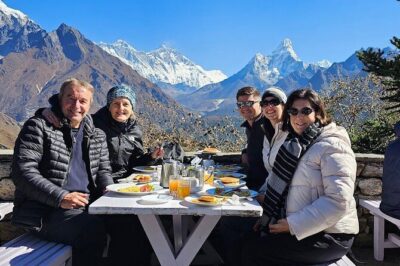
Everest Base Camp Helicopter Tour landing at Everest View Hotel
Read our review →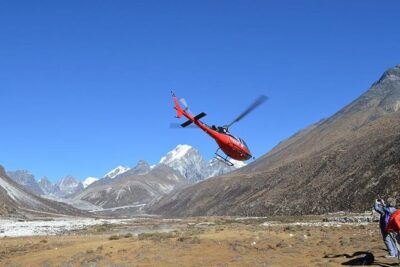
Everest Base Camp Helicopter Tour landing at Hotel Everest View
Read our review →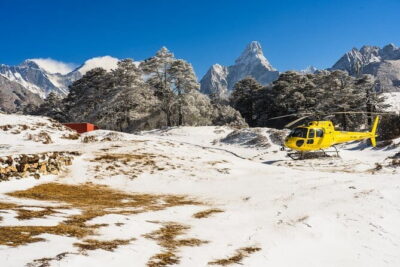
Everest Base Camp helicopter tour with landing
Read our review →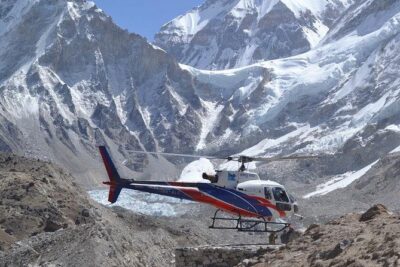
Everest Base Camp Helicopter Tour with Hotel Everest View Landing
Read our review →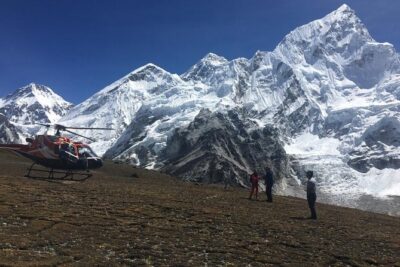
Guaranteed Landing at Everest Base Camp Kalapathar by Helicopter
Read our review →Everest Base Camp Helicopter Tour landing at Everest View Hotel.
Read our review →
Everest Base Camp Trek with Helicopter Return to Lukla – 10 Days
Read our review →