
REVIEW · BIG ISLAND
Big Island: Discover Hilo Helicopter Tour
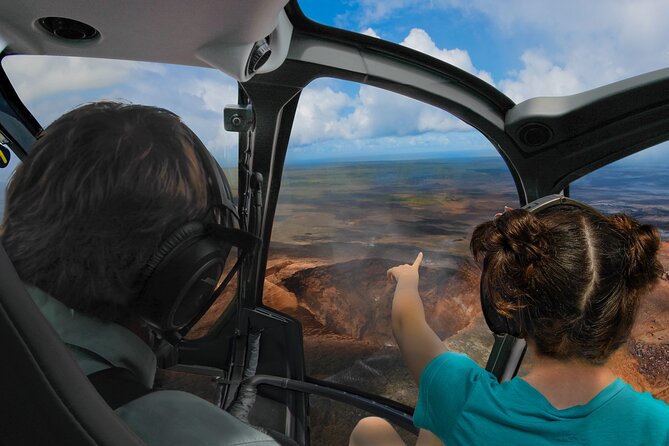
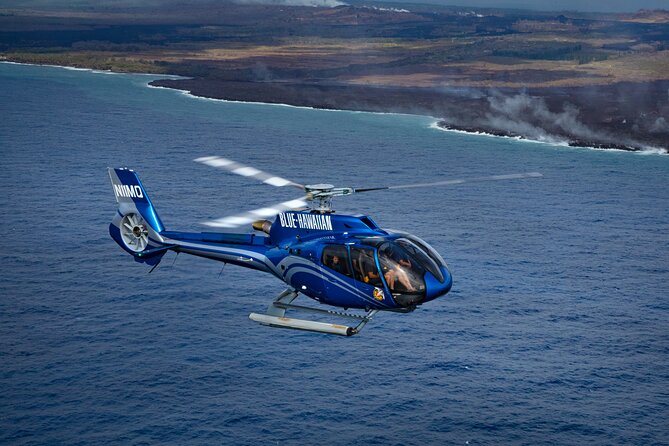
A helicopter is the best way to understand the Big Island’s size and volcanic force in one short outing. From Hilo Airport, you’ll look down on Hilo Town, rugged lava shores, waterfalls, craters, and huge stretches of Hawaii Volcanoes National Park that roads cannot reach. The front-facing seats and 180-degree views make the 50-minute flight especially good for seeing the ground below.
I like the small maximum of six passengers, which keeps the aircraft from feeling like a sightseeing bus with wings. I also like the two-way microphones: pilots such as David, Ryan, Chewy, and Bastian have been praised for clear explanations and calm flying. The catch is simple but important: weather and volcanic activity control what you actually see, so the advertised Kilauea and Mauna Loa views are not guaranteed.
Key points to know before you fly
- Six passengers maximum: The small Airbus Eco-Star creates a more personal flight and gives you a better chance of seeing out.
- Kilauea is not guaranteed: Low cloud, rain, safety decisions, or a quiet crater can change the route.
- Hilo is the departure point: You must arrange your own transport and pay the $10 parking charge if you drive.
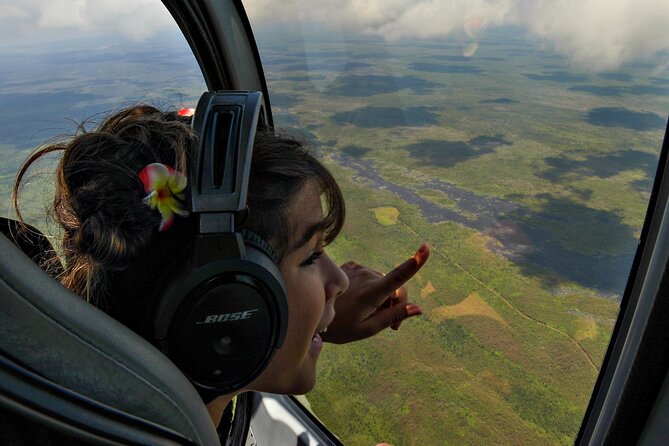
- The pilot is your guide: State of Hawaii certified guides provide commentary through Bose aviation headsets and two-way microphones.
- Plan around the 45-minute check-in: Staff weigh passengers, give a safety briefing, and seat everyone before departure.
- The price is $482.90 per person: It is a major splurge, but it covers a rare view of remote volcanic country in a compact 50-minute flight.
What this Hilo helicopter flight actually shows you
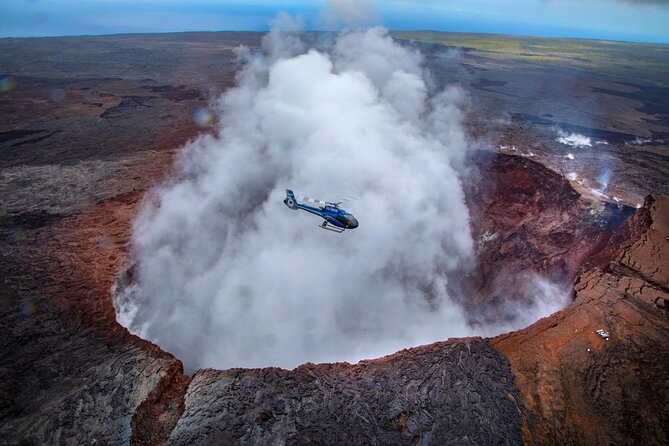
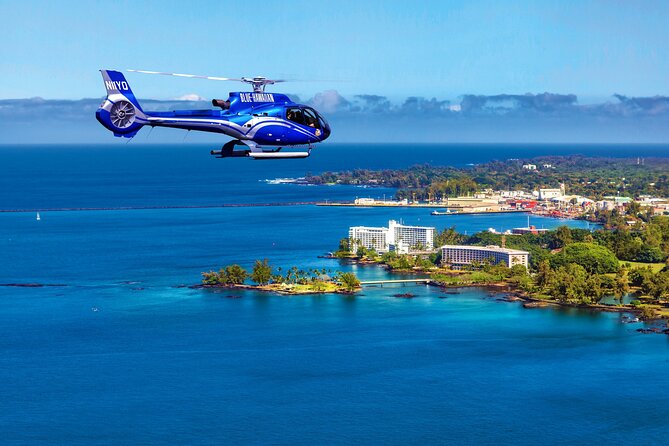
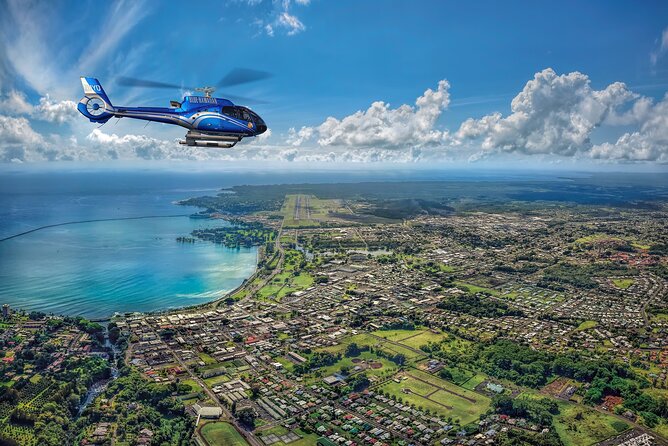
The route begins over Hilo Town, described as having its first habitation around 1100 AD. From the air, you get a quick sense of how the town sits beside Hilo Bay, with the ocean, streets, and surrounding greenery arranged in a way that is hard to grasp from ground level.
The flight then follows the shoreline near the volcanic area. This is where the Big Island starts to make visual sense. Historic lava flows meet the coast, and newer volcanic ground appears beside older sections. From a car, you see isolated black rock or a roadside sign. From above, you can trace how molten rock once moved toward the sea and how the island continues to grow.
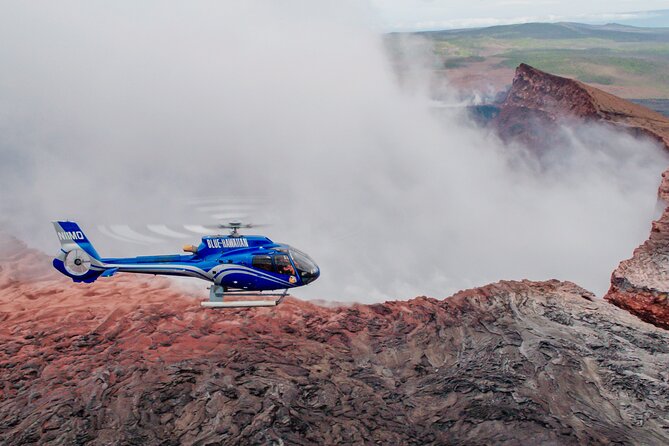
The main goal is Hawaii Volcanoes National Park, with attention to Kilauea and Mauna Loa. You may see Halemaumau Crater, old lava flows, fresh volcanic formations, and the broad volcanic slopes. The exact view depends on cloud cover, rain, volcanic conditions, and the pilot’s safety judgment.
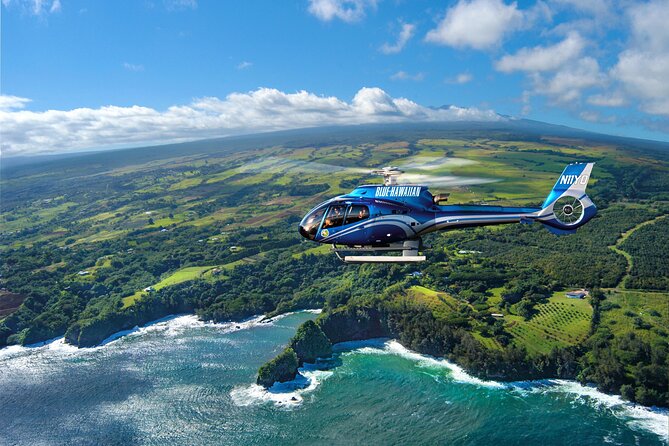
The Hamakua Coast and Hawaiian waterfalls add variety. A flight devoted only to craters could become visually repetitive, especially if volcanic activity is low. Waterfalls, coastal cliffs, rainforest areas, and Hilo Bay give you a fuller picture of the island.
You might also spot wildlife. One flight included spinner dolphins, and another saw whales. Those sightings are extras, not part of the promised route, so I would treat them as good luck rather than a reason to book.
More Coastal Helicopter Tours in the USA
- West Maui and Molokai Special 45-Minute Helicopter Tour
★ 5.0 · 759 reviews - Doors Off West Maui and Molokai 45 minute Helicopter Tour
★ 5.0 · 487 reviews - 1000 Islands: 10, 20, 30, or 60-Min Scenic Helicopter Tour
★ 4.9 · 412 reviews
The Airbus Eco-Star and the view from your seat
The aircraft is an Airbus Eco-Star with forward-facing seats. That seating arrangement matters. You are not simply looking sideways through a small window while the aircraft moves past the view. You face ahead and get a broad 180-degree field of view, which helps when the pilot points out a crater, waterfall, lava flow, or coastal feature.
The flight uses Bose aviation-grade electronic noise-canceling headsets. You also receive a microphone that lets you speak with the pilot. This is more useful than it may sound. Helicopters are loud, and without a headset, even a good explanation can become a blur of engine noise.
The small six-person limit is another real advantage. It does not guarantee that every seat has the same view, but it keeps the group intimate and makes it easier for the pilot to address the people aboard. Some passengers have paid extra for a front seat and felt it was worth the added cost. Ask about seat options when booking, since a preferred position may carry a separate charge.
Do not bring bags, large cameras, or extending selfie sticks into the helicopter. The operator also offers USB video and photo packages for purchase after the flight. I would decide beforehand how much you value an official recording, since the added sales pitch can take some shine off the relaxed finish for people who are not interested.
Why the volcano views are so special, and so uncertain
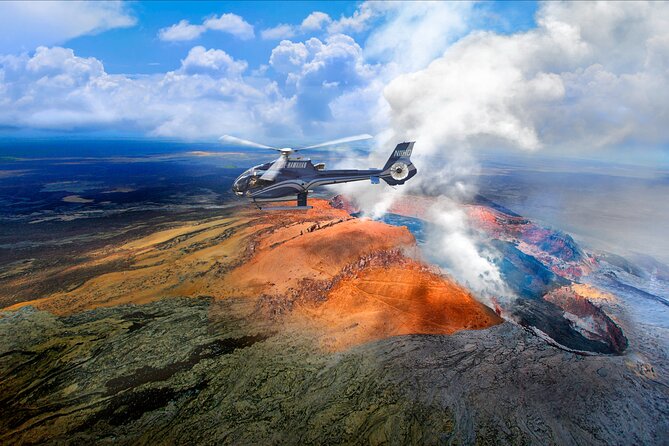
A helicopter flight is particularly useful on the Big Island because the volcanic area is enormous. Roads reach only certain points, and a ground visit gives you a close look at selected craters and lava fields. From the air, you can see the wider pattern: old flows, newer scars, coastlines, and the relationship between Kilauea and Mauna Loa.
Still, the name of the tour should not lead you to expect a guaranteed close view of Kilauea. If the crater is not erupting, some passengers have felt disappointed that the route did not pass directly over it. Others have found the old flows and craters impressive even without glowing lava.
Rain and low cloud are an even bigger factor. One flight was offered a refund after low clouds made clear views unlikely. On another outing, the pilot initially hesitated to approach the volcano because of rain, then showed earlier volcanic destruction when conditions improved.
That is not necessarily poor service. Helicopter routes must follow safety limits, and a pilot cannot promise a clear crater on a cloudy day. But you should book this as a flight over volcanic country, not as a guaranteed lava spectacle. If your main goal is one particular crater, check the current eruption and weather situation before paying.
The pilot makes a large difference
Your pilot is also your guide, and the quality of the commentary shapes the whole experience. Strong pilots explain what you are seeing, point out historic flows, provide island history, and tell you where to look before the aircraft passes a feature.
Several named pilots have received especially warm praise. David has been described as friendly, informative, and good at directing attention to the right sights. Ryan has been praised for his smooth, confident handling. Chewy has provided clear information about volcanoes and adapted well during an eruption. Bastian has been singled out as both an excellent guide and pilot.
The supplied experiences also show why expectations should stay realistic. One passenger found the explanation of the caldera and craters too limited, while another felt the pilot did not spend enough time at the waterfalls. The route can change, and not every pilot will narrate with the same energy or depth.
The best approach is to listen through the headset and ask questions when the microphone is open. You may hear historical information about lava flows and eruptions, along with practical help identifying what lies below. A pilot who points out a feature before you pass it can turn a fast view into a memorable one.
Same place, a different flight path:
- New York City: Manhattan Helicopter Tour
★ 4.7 · 7,076 reviews - NYC: Manhattan Sightseeing Helicopter Tour
★ 4.8 · 5,826 reviews - Las Vegas Helicopter Night Strip Flight Tour with Optional Dinner
★ 4.5 · 5,693 reviews - Grand Canyon Village: Helicopter Tour & Hummer Tour Options
★ 4.7 · 2,586 reviews
A closer look at the 50-minute route
Hilo Town and Hilo Bay
The opening view gives you an aerial introduction to Hilo. You see the town in relation to the bay and the surrounding volcanic island, rather than as a collection of separate streets and buildings.
This section is useful at the start because it gives you orientation. If Hilo is your base, you can later recognize the shoreline and understand how the town fits into your wider Big Island itinerary. It is not the main reason to pay $482.90, but it helps the flight begin with a sense of place.
The volcanic shoreline
Following the shore near the volcano area brings you close to the island’s changing edge. Historic lava flows show where earlier eruptions reached the sea, while newer formations reveal how temporary and exposed the coast can look.
The view is much more powerful from above than from a single roadside stop. You can compare different ages of volcanic ground at once. The drawback is that the aircraft cannot pause in the way you can at a viewpoint, so the pilot’s narration and your ability to spot details matter.
Kilauea, Mauna Loa, and Halemaumau Crater
This is the heart of the outing. Kilauea and Mauna Loa are the major volcanic names, while Halemaumau Crater gives you a specific feature to look for. On a clear day, the sight of broad volcanic slopes, crater forms, and old flows can be astonishing.
The word active needs care here. Volcanic activity can change, and a crater may be quiet when you fly. You might see dramatic scars from earlier eruptions rather than molten lava. If conditions prevent the aircraft from reaching the main volcanic sights, the flight may focus more on the coast, waterfalls, and older flows.
Waterfalls and the Hamakua Coast
The waterfalls and Hamakua Coast provide a welcome change from black volcanic rock. The coastline, forested areas, and falling water add color and texture to the route.
Some passengers hoped for a closer waterfall pass and felt the aircraft stayed too far away. That is a fair concern if waterfalls are your main interest. For me, they work best as part of the larger flight rather than as a separate waterfall tour.
Newly formed ground and old lava flows
The final volcanic views help you see the island as something still being built. New ground and historic flows are not just scenic objects. They explain why the Big Island looks so different from older Hawaiian islands.
This is also where the aerial perspective earns its keep. On the ground, black rock can seem empty and disconnected. From above, flow lines and broad areas of destruction tell a clear story.
Price, timing, and the value question
At $482.90 per person, this is not a casual add-on. A couple will spend nearly $1,000 before any optional photo or video package, gratuity, parking, or transport costs. The flight lasts about 50 minutes, so the price is high when measured by the clock.
The value is in access. You are paying to see volcanic areas, coastlines, and formations that are not accessible by vehicle, with a state-certified guide explaining them in real time. If you have limited time on the Big Island, the flight gives you a wide survey in less than an hour.
I think the cost makes the most sense for a first visit, a special occasion, or anyone who values aerial views more than a low-cost day of sightseeing. It is harder to justify if you already plan a detailed visit to Hawaii Volcanoes National Park and mainly want to see one quiet crater.
Morning and afternoon departures make scheduling easier. I would choose the time that gives you the best chance of clear weather, while remembering that conditions can change quickly. The flight is often booked well ahead, with an average booking lead time of about 52 days, so do not wait until the last minute if your dates are fixed.
Check-in, weight limits, and small practical details
Arrive at Blue Hawaiian Helicopters in Hilo 45 minutes before departure. This is not optional padding. Staff need time for passenger weight checks, the safety briefing, and seating everyone so the aircraft can leave on time.
Each passenger has a total weight limit of 240 pounds. If you weigh more than that, an adjacent empty seat is required for balance, charged at half the regular tour price. Arrange that extra seat after booking rather than leaving it to the day of the flight.
Transportation to the heliport is not included. Public transportation is nearby, but you must arrange your own way there. If you drive, parking costs $10.
Children 23 months and younger can fly free as lap children. The tour is suitable for most people, though you should consider your comfort with a helicopter, noise, and a flight where the scenery may change because of weather.
No scuba diving is allowed within 24 hours of departure. Gratuity is also not included and is left to your discretion.
Weather, cancellations, and what happens if plans change
The experience requires good weather. If poor conditions force a cancellation, you can choose another date or receive a full refund. The same general choice applies if the minimum number of passengers is not met.
You can cancel for a full refund up to 24 hours before the start time. Cancellations or changes made within 24 hours are not refunded or accepted. Late arrival is also non-refundable, so allow extra time if you are coming from a cruise ship or another part of Hilo.
The strict arrival rule matters. One passenger nearly missed the flight after not realizing the 45-minute check-in requirement. Put the heliport arrival time into your day plan, not just the takeoff time.
Who will enjoy this flight most
I would recommend it most to you if you want a broad view of the Big Island and accept that nature sets the schedule. It is especially good for first-time visitors, photographers who can work within the bag restrictions, couples marking a special trip, and families with older children who can appreciate the volcanic story.
It is also a good choice if a ground visit to Hawaii Volcanoes National Park is already on your plan. The two experiences complement each other. From the ground, you get time to walk and study a crater. From the helicopter, you see the scale of the island and the full reach of the lava flows.
I would be more cautious if your budget is tight, if you are set on seeing active lava, or if you dislike the uncertainty of weather-based sightseeing. You may pay a premium and still receive a shorter volcanic route or no direct Kilauea view.
Should you book the Big Island Discover Hilo Helicopter Tour?
Book it if you want access to remote volcanic scenery and value a small aircraft, clear headset commentary, and a wide aerial view more than a bargain price. The strongest parts are the six-person limit, forward-facing seats, skilled pilots such as David, Ryan, Chewy, and Bastian, and the chance to see the Big Island’s volcanic structure in one sweep.
Do not book it expecting a guaranteed eruption or a fixed close-up of every named sight. Choose a date with some flexibility, arrive early, ask about seating, and treat the waterfalls and wildlife as bonuses. For the right budget and the right expectations, this is one of the clearest ways to understand why the Big Island feels less like a single destination and more like a living island still being made.
FAQ
How long is the Hilo helicopter tour?
The flight lasts approximately 50 minutes.
Where does the helicopter tour begin and end?
It begins and ends at Blue Hawaiian Helicopters in Hilo, Hawaii. The activity returns to the same meeting point.
How early should I arrive?
You should check in 45 minutes before your scheduled tour time. This allows time for passenger weight checks, the safety briefing, and aircraft seating.
What sights might I see from the helicopter?
The route may include Hilo Town, Hilo Bay, Kilauea, Mauna Loa, Halemaumau Crater, Hawaiian waterfalls, the Hamakua Coast, newly formed volcanic ground, and historic lava flows. Sights vary with weather and conditions.
How many people can join the flight?
The maximum is six travelers, creating a smaller group experience.
Is transportation to the heliport included?
No. You must arrange your own transportation. Parking at the heliport costs $10.
What happens if bad weather cancels the flight?
You will be offered a different date or a full refund. You can also cancel at least 24 hours before the start time for a full refund. Cancellations made less than 24 hours before departure are not refunded.
Just added around the USA
- Zion National Park and Canaan Cliffs: Helicopter Tour★ 4.7 · 22 reviews
- Zion National Park, Canaan Cliffs: Extended Helicopter Tour★ 4.5 · 4 reviews
- Zion National Park: 10- or 20-Minute Scenic Helicopter Tour★ 4.9 · 55 reviews
- West Maui and Molokai Special 45-Minute Helicopter Tour★ 5.0 · 9 reviews
- Waikoloa: Big Island Spectacular Helicopter Tour★ 4.5 · 5 reviews
- Oahu: Waikiki 20-Minute Doors On / Doors Off Helicopter Tour★ 4.9 · 32 reviews
- Las Vegas: Valley of Fire Helicopter with Scenic Landing★ 5.0 · 2 reviews
- Hudson Valley Fall Foliage Helicopter Tour from Westchester (Shared)★ 4.0 · 2 reviews
Island & Coastal Helicopter Tours, compared.
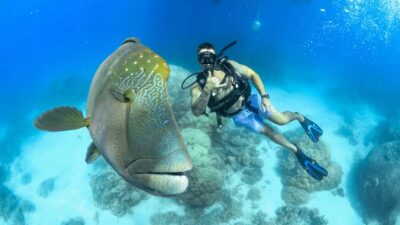
Cairns: Great Barrier Reef Cruise & Scenic Helicopter Flight
Read our review →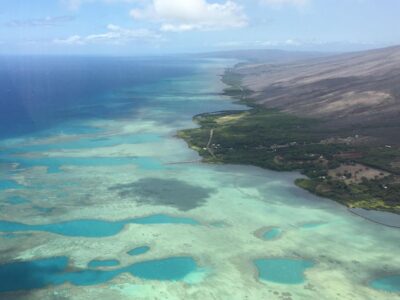
West Maui and Molokai Special 45-Minute Helicopter Tour
Read our review →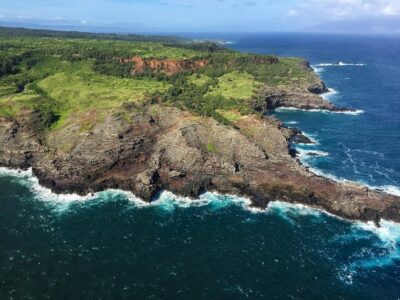
Doors Off West Maui and Molokai 45 minute Helicopter Tour
Read our review →
1000 Islands: 10, 20, 30, or 60-Min Scenic Helicopter Tour
Read our review →
Full Day Reef Cruise and 10 Minute Helicopter Scenic Flight
Read our review →

Browse the lists this tour appears in